
On June 8, the 23rd World Congress of Soil Science opened in Nanjing. Held under the theme “Soil and the Shared Future for Humanity”, the event was co-hosted by the International Union of Soil Sciences (IUSS) and the Soil Science Society of China, and organised by the Institute of Soil Science, Chinese Academy of Sciences.
The event will last five days, during which 9 symposia, 5 interactive thematic workshops, over 100 parallel forums, more than 800 poster presentations, and over 2,000 oral presentations will be held. Additionally, 6 mid-event field trip routes and 4 post-event field trip routes will be offered, providing global experts and scholars with diverse and rich opportunities for academic exchange and on-site discussion.
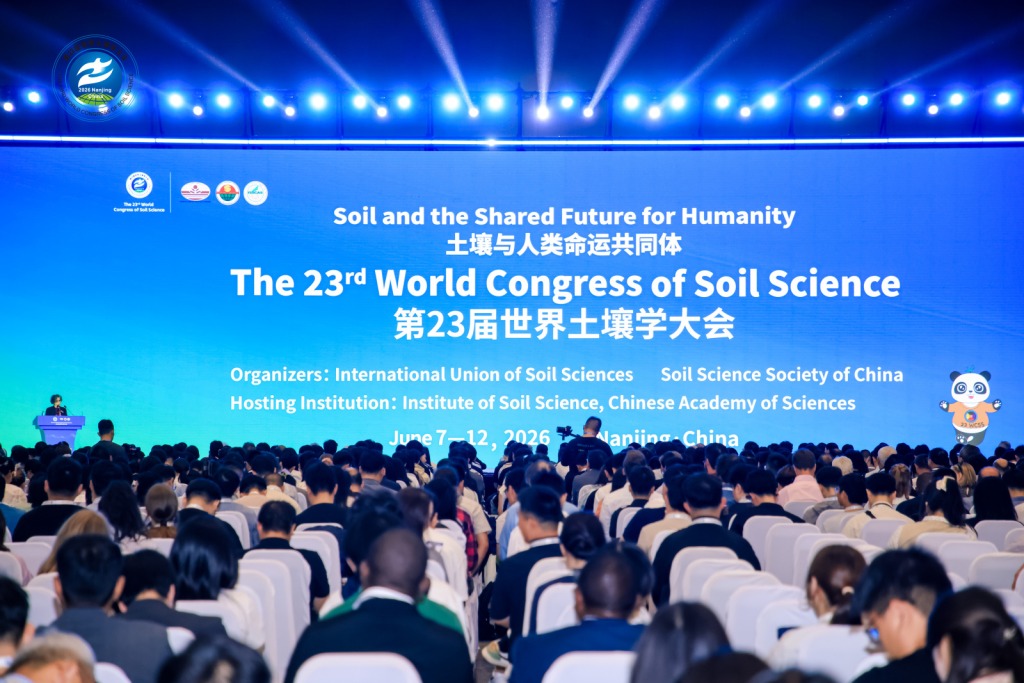
The World Congress of Soil Science was first held in 1927, starting as a small forum of around one hundred participants in Washington, D.C. It takes place every four years and is often called the “Olympics” of soil science. This year marked the first time in nearly a century that the congress was hosted in China. Close to 3,000 experts, scholars, representatives from international organisations and businesses gathered in Nanjing from more than 100 countries to discuss soil health, gobi conservation and restoration, and sustainable soil development—and to engage in academic exchanges and international cooperation.
Nanjing is widely regarded as the birthplace of modern soil science in China. Over the past century, Chinese researchers have grown from participants to leaders on the global stage. In 1935, three Chinese scientists—Hou Guangjiong, Deng Zhiyi and Zhang Naifeng—presented their work at the congress for the first time. In 2018, China beat Canada in its bid to host the 23rd World Congress of Soil Science. Today, China’s soil scientists have moved from learning from other countries to offering solutions of their own.
International experts spoke highly of the congress. Professor Deli Chen, a fellow of the Australian Academy of Science, noted that Chinese soil science research has been firmly in the world’s top tier for the past 20 years. Michael Thompson, a past president of the Soil Science Society of America, praised China’s diverse soil types and rapidly advancing research. Nora Berrahmouni, deputy director of the Land and Water Division at the Food and Agriculture Organization of the United Nations, pointed out that more than 60 percent of the world’s farmland is degraded, calling for multi stakeholder collaboration to protect our soils. Bruce Lascelles, president elect of the International Union of Soil Sciences, said that the congress has achieved an unprecedented scale and quality, and that soil science will become a core global concern over the next five to ten years.